There is no known number to my Ethnicity for now I remain from the Carbon Copy that engulfs all color and light.
Kit: Hellenic Ottoman (MA2196)
Your closest Ancient populations.
Your DNA matches these ancient populations based on real archaeological samples from over 150 Ancient Civilizations.

Seleucid Empire, Ottomans, Pontic Empire, Romans, Gepids
Following the death of Alexander the Great, the Macedonian Empire was divided. Alexander's infantry general Seleucus I Nicator founded the Seleucid Empire which included much of Alexander's near eastern territories. At the peak, this included central Anatolia, Persia, the Levant, Mesopotamia, Kuwait, Afghanistan and parts of Pakistan and Turkmenistan. The Seleucid Empire was a major center of Hellenistic culture and maintained Greek customs with a Greek elite dominating urban areas. The cities were populated by Greeks who re-enforced largescale immigration from Greece. The Empire tried to expand further but was thwarted by the Roman Republic and its Greek allies leading to defeat at the Battle of Magnesia. The Seleucids were forced to pay costly war reparations and give up territories west of the Taurus Mountains. The Seleucid kings continued to rule until invasion by the Armenian king Tigranes the Great in 83 BC and their ultimate overthrow by the famous Roman general Pompey in 63 BC.
The Ottoman Empire grew to be one of the most powerful states in the world during the 15th and 16th centuries. At the height the empire encompassed most of southeastern Europe to the gates of Vienna, including present-day Hungary, the Balkan region, Greece, parts of Ukraine and the Middle East, North Africa and large parts of the Arabian Peninsula. The term Ottoman is a dynastic appelation derived from Osman I, the nomadic Turkmen chief who founded both the dynasty and the empire in 1300. The Ottoman period spanned more than 600 years and came to an end only in 1922 when it was replaced by the Turkish Republic and various successor states in southeastern Europe and the Middle East.

The Pontic Empire centered around the Black Sea and was founded by the Persian Mithridatic dynasty with a mixed population of Hellenic Greek settlers and people from Persia and the Steppes. The kingdom was Hellenized and the offical language was Greek. It was divided into two distinct areas - the coastal region and the Pontic interior. The coastal region bordering the Black Sea was separated from the mountainous inland by the Pontic Alps. The coastal regions were dominated by Greek cities such as Amastris and Sinbope which became the Pontic capital. The coast was rich intimber, fishing and olives, and the region also had rich supplies of iron, silver, copper and other metals. The Hellenic coastal regions focused on sea trade, whereas the interior was ruled by Iranian aristocracy that had a history back to the Persian Empire. The gods of the kingdom were a mix of Persian and Greek deities including the Persian Ahuramazda, Apollo and Mithras. The Pontic culture was a synthesis between Iranian, Greek and Anatolian elements. Eventually pirate activity increased in the Eastern Mediterranean enabling the Roman General Pompey to invade. The western half and Greek coastal cities were annexed by Rome directly, whereas the interior and eastern kingdom remained an independent client kingdom of Rome.

The founding of mighty Rome starts with the story of Romulus and Remus. Whether they were suckled by a she-wolf as infants or descended from the Trojan War hero Aeneas, the Latins who settled Rome had their crude dwellings tranformed into a true city by their Etruscan overlords. The Etruscans were master builders who gave Rome its architecture, gods, and gladiators. After overthrowing their conquerors, the Roman Republic expanded quickly to incorporate the Latins, Etruscans (originally from Anatolia), Greek settlers to the south and Gauls to the north. Republic gave way to Empire and after a thousand years it was time for Rome to face its end. Although numerous invaders arrived on the scene as the empire weakened and crumbled, the wars with the Ostrogoths from 535-554 AD had a lasting impact that left Italy devastated and depopulated.

Gepids were a Germanic tribe realted to the Goths, described as tall and blond-haired. The Gepids fought alongside the Huns against the Roman Empire around 440 AD. Later the Gepids founded a kingdom known as Gepidia in the eastern regions fo the Carpathian basin. They helped form a coalition to fight the Ostrogoths who ruled Pannonia. They reached their peak in 537 and settled further near modern Serbia. In 546 the Byzantines allied with the Lombards and crushed the Gepids. Any remnants were defeated by the Avars in 567 who took over all the former Gepid lands.

Seleucid + Ottoman (6.846)
Ottoman + Pontic (8.088)
Roman + Ottoman (9.484)
Ottoman + Gepid (9.595)
Pontic + Gepid (10.19)
Seleucid (13.69)
Ottoman (14.39)
Pontic (16.17)
Roman (18.96)
Gepid (19.19)
What do these numbers mean?
Genetic distance measures how close you are to a given sample.
10 means this is your ancient ancestry
20 means this is part of your ancestral link
30 means possibly related to your ancestry
Ancient Sample Breakdown:

What is my Ancient Sample Breakdown?
Your DNA matches many ancient individuals from history. This chart represents a union of all your matching samples and their own individual classification. The displayed result is your personalized ancestral breakdown.
You have ancient relatives! (you share identified DNA segments)
Iron Age Armenia Lorid Berd Cemetery 663 BC I13949
mtDNA: T1Y-DNA: J1 (L255)
Shared DNA: (Sample Quality: 2)
2 SNP chains (min. 60 SNPs) / 82.38 cM
Largest chain: 143 SNPs / 47.19 cM
Your raw DNA is 100 % closer than other matching users
Chr. 8 143 SNPs
Chr. 12 105 SNPs
In the enigmatic embrace of the Iron Age, nestled within the verdant highlands of Armenia, a remarkable discovery was madea grave hailing from around the 7th century BC that brought to light the remains of an individual who provides us with an insightful look into a time and place that often whispers secrets through the soil of ancient burial grounds.
Lying at eternal rest within the historic confines of the Lorid Berd Cemetery, this male who lived and died over two-and-a-half millennia ago carried within his very bones the code to his ancestral lineage. His Y-DNA belongs to Haplogroup J1, indicative of Middle Eastern origins that stretch deep into the Neolithic period, while his mitochondrial DNA, assigned to Haplogroup T1, tells us of maternal connections that again likely have origins tracing back to the Fertile Crescent.
PCA Analysis

Closest ancient;
Nairi + Parthian (15.69)
Nairi (16.71)
Nairi + Urartu (16.79)
Nairi + Safavid (16.91)
Parthian + Urartu (17.02)
Parthian + Alan (18.08)
Urartu (19.9)

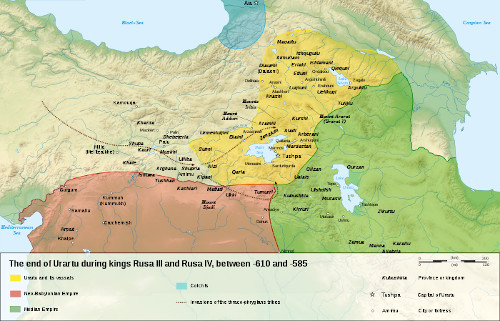
Nairi ConfederationThe Nairi were a Late Bronze Age confederation located in the Armenian highlands and Pontic region of Asia Minor. They were in conflict with the Hittite Empire in the 14th century. They were a force strong enough to contend with both Assyria and Hatti. The Nairi lands were inhabited by fierce tribal groups divided into a number of principalities. First mentioned by the Assyrian king Tukulti-Ninurta who claimed to have defeated forty of their kings, they are also documented by Hittite texts as likely corresponding to the Azzi confederation. In 882 BC, the Assyrian king Assurnasirbal II invaded Nairi which at the time had 4 known regions: Bit-Zamani, Shubru, Nirdun and Urumu/Nirbu. There was a clear seperation of entities between the Urartu and Nairi - however over time the Urartu conquered so much of the Nairi lands that the Urartian kings decided Nairi was a suitable name for the kingdom they ruled. Over time the Nairi peoples as a seperate group disappeared and by the 7th century BC the term referred simply to a province of Assyria.

The Kingdom of Urartu was a civilization which developed in the Bronze Age of ancient Armenia, Eastern Turkey and northwestern Iran. The kingdom boasted a strong military and had many skilled metalworkers. The name Urartu comes from the Assyrian word for the kingdom and signifies a high place. They were known to Babylonians as Uruatri and the Hewbrews as Ararat. They began as a confederation of kingdoms which had developed from the 14h to 13th centuries BC. They prospered on an extensive fertile plateau full of crops including wheat, barley, millet, rye, sesame and flax. The Urartu also managed livestock and were skilled winemakers - in fact they built a 51km canal for vineyards! The government was a monarchy with the fortress capital Tushpa with a population as high as 50,000 at its peak.
Closest modern;
1. Kumyk (21.20)
2. Lezgin (22.52)
3. Tabassaran (22.63)
4. Azeri (23.51)
5. Armenian (24.25)
6. Kurdish (24.38)
7. Turkish (24.62)
8. Iranian (25.34)
Haplogroup Analytics
A female inherits an mtDNA haplogroup from their mother, whereas a male inherits both the mtDNA haplogroup and a Y-chromosome haplogroup.
Depending on the quality of each ancient sample, we can determine one or both.
A mtDNA haplogroup specifies the all female lineage of any sample, whereas the Y-DNA haplogroup determines the all male lineage.
For all the ancient samples we have which match your kit, we have collected the mtDNA and y-DNA haplogroups and combined them into a chart.
This chart is a personalized estimation of your haplogroup ancestry - e.g. your Ancient Ancestors collectively may have the haplogroups distributed as shown!
The highlighted number is a percentage of the total haplogroup set.
This is Y-DNA distribution of all the samples which match this kit;

Haplogroup 93 - Late Kushan Empire Central Asia (L8005)
Archaeological Identifier: L8005
mtDNA: 111
Y-DNA: 93
Closest modern;
1. Nogai (18.09)
2. Tatar_Crim (20.22)
3. Tatar_Lithuania (23.15)
4. Tatar (23.71)
5. Serbian (24.10)
6. Romanian (25.19)
7. Tadjik (25.22)
8. Macedonian (25.94)
Closest ancient;
Sarmatian + Gaul (11.78)
Sarmatian (12.64)
Sarmatian + Pontic (12.64)
Sarmatian + Cimmerian (13.17)
Gaul + Cimmerian (13.44)
Pontic + Cimmerian (15.05)
Cimmerian (16.9)
In the expanse of what once was the Late Kushan Empire, the whispers of an ancient individual speak to us through the sands of time. Around the second century AD, when the Kushan domain stretched with grandeur across Central Asia, a man, part of the tapestry of a diverse and cosmopolitan society, drew his last breath. His remains offer us a unique window into a past that still captivates the imagination, holding stories etched in bone and earth.
This man, who lived and died at the zenith of the Kushan's power, was interred with a certain reverence, a testimony to the complex funerary practices of his culture. His remains, robust with the tales of bygone eras, were discovered in an archaeological endeavor that peeled back the layers of history with careful hands. Through the marvels of modern science, his Y-DNA haplogroup was revealed to be G3, an ancient lineage that traces back to early human migrations, while his mtDNA put him in haplogroup U7, suggesting a maternal line that spoke of local legacies and migrations across the steppes of Asia.
Around him, artifacts whispered of his world-coins that jingled in the markets of the Kushan cities, where Bactrian, Greek, and Prakrit tongues mingled. Pottery shards painted with tales, perhaps carrying wine that warmed the souls in the cold desert nights, and textiles that swirled with colors, traded along the Silk Road. These objects, mundane yet magical, are relics of a life once lived. They are shards of a daily existence that was as vibrant and tangible as our own.
This is mtDNA distribution of all the samples which match this kit;

Your Y-DNA Royalty Breakdown
Your Deep Dive matches (where you share DNA segments) share the following Royal Y-DNA haplogroups
House of Manfredi 8.78%
Migration Period Hungary Rakoczifalva Sample #3
650 AD (RKF032) Genetic Distance: 9.586
mtDNA: J1c9
Y-DNA: J2b2a1a1a1a1a1a1e
Avar Elite Hungary Rakoczifalva Sample #4
650 AD (RKC011)
Genetic Distance: 9.792
mtDNA: J1c5d
Y-DNA: J2b2a1a1a1a1a1a1e
Migration Period Hungary Rakoczifalva Sample #5
650 AD (RKF031)
Genetic Distance: 9.988
mtDNA:M8a2b
Y-DNA:J2b2a1a1a1a1a1a1e
Avar Elite Hungary Rakoczifalva Sample #7
650 AD (RKC043)
Genetic Distance: 10.39
mtDNA:J1c5d
Y-DNA:J2b2a1a1a1a1a1a1e
Migration Period Hungary Rakoczifalva Sample #8
650 AD (RKF170)
Genetic Distance: 10.59
mtDNA:H13a1a1
Y-DNA:J2b2a1a1a1a1a1a1e
Migration Period Hungary Rakoczifalva Sample #10
650 AD (RKF141)
Genetic Distance: 10.79
mtDNA:M8a2b
Y-DNA:J2b2a1a1a1a1a1a1e
House of Gontaut 6.24%
Uguumur Uul Xiongnu Period Mongolia
50 AD (UGU006)
Total shared SNPs: 444.0
Largest SNP chain: 123.0
mtDNA:Z1a
Y-DNA:J1a2a1a2d2b2b2c4b
Imperial Rome Cluana Ancona 165 AD (R835)
Total shared SNPs: 1162.0
Largest SNP chain: 141.0
mtDNA:H2a5
Y-DNA:J1a2a1a2d2b2b2c
Kohanim 4.73%

Migration Period Hungary Rakoczifalva Sample #1
650 AD (RKF192)
Genetic Distance: 9.495
mtDNA:H26
Y-DNA:J1a2a1a2d2b2b2
Imperial Rome Cluana Ancona
165 AD (R835)
Total shared SNPs: 1162.0
Largest SNP chain: 141.0
mtDNA:H2a5
Y-DNA:J1a2a1a2d2b2b2c
Clan Finney 2.91%
Scythian Nomadic Rich Grave Psiochyn Kharkiv Sample #347
400 BC (UKR132)
Genetic Distance: 22.01
mtDNA:X2f
Y-DNA:R1b1a1b1
Carthaginian Sardinia Villamar
250 BC (VIL011)
Total shared SNPs: 116.0
Largest SNP chain: 116.0
mtDNA:K1a3a
Y-DNA:R1b1a1b1a2
English Royalty 2.03%
Avar Elite Hungary Hajdunanas Sample #22
650 AD (HNJ002)
Genetic Distance: 11.72
mtDNA:H11a
Y-DNA:R1b1
Iron Age Russia
300 BC (Rise492)
Total shared SNPs: 1951.0
Largest SNP chain: 187.0
mtDNA:?
Y-DNA:R1
Urartian Kingdom Teishebani Karmir Blur Armenia Sample #152
850 BC (I3892)
Genetic Distance: 18.83
mtDNA:K1
Y-DNA:G2b2
Bronze Age Boatbridge Quarry South Lanarkshire Scotland Sample #182
2250 BC (I5473)
Genetic Distance: 19.43
mtDNA:U5b1
Y-DNA:R1b1a1b1a1a2c1a
Bronze Age Wehringen Sample #186
1972 BC (WEHR_1474)
Genetic Distance: 19.49
mtDNA:V
Y-DNA:R1b1a1b1a1a
Post Roman Empire South Tyrol Malles Burgusio Santo Stefano Sample #192
450 AD (2428a)
Genetic Distance: 19.58
mtDNA:H5
Y-DNA:R1
Crusader Knight Tuscan / Lebanon Sample #251
1250 AD (SI-53)
Genetic Distance: 20.53
mtDNA:T2w
Y-DNA:R1b1a1b1a1a2c1b
Austrian Royalty 1.52%
Avar Elite Hungary Hajdunanas Sample #22
650 AD (HNJ002)
Genetic Distance: 11.72
mtDNA:H11a
Y-DNA:R1b1
Iron Age Russia
300 BC (Rise492)
Total shared SNPs: 1951.0
Largest SNP chain: 187.0
mtDNA:?
Y-DNA:R1
House of Lippe Detmold 1.47%
Clan Armstrong 1.47%
Crusader Knight Tuscan / Lebanon Sample #100
1250 AD (SI-41)
Genetic Distance: 17.17
mtDNA:V40a
Y-DNA:R1b1a1b1a1a2a
Bronze Age Wehringen Sample #186
1972 BC (WEHR_1474)
Genetic Distance: 19.49
mtDNA:V
Y-DNA:R1b1a1b1a1a
Clan Stewart
(R1b1a1b1a1a2c1a1a1a1a1b )
Clan LogoClan Tartan Virescit Vulnere Virtus
This Latin motto translates to Courage grows strong at a wound. It suggests that the Clan Stewart grows stronger in the face of adversity and challenges, much as a person's resolve might solidify when they are wounded or under threat.
You share DNA with the dynasty associated with this castle ...
Y-DNA Matches;
Scottish Royalty


Differences: 2
Delta: 0
Deep Dive Matches
(shared DNA segments)
Late Period Ancient Egypt (JK2911) 650 BC
Total SNPs: 662.0
Late Period Ancient Egypt - JK2911
J2b1 - delta:0
Ah, let us delve into the fascinating life and times of an individual from Late Period Ancient Egypt, who walked the banks of the Nile some 2,650 years ago. His genetic lineage whispers tales of bygone eras, with paternal ancestry rooted in the Y-DNA haplogroup J2b1, indicating connections that may trace back to the Fertile Crescent. This bears witness to the ancient movements of peoples, as Mediterranean cultures intertwined with those of Egypt. On his mother's side, the MTDNA haplogroup M1a1 presents a tapestry of maternal heritage, possibly originating from eastern Africa or the Near East, enriching our understanding of the genetic melting pot that was the Nile Valley.
Wrapped in the embrace of the sand for untold centuries, the mans remains offer a gateway into the customs and daily life of his time. Late Period Egypt was a time of both turmoil and opulence, as the nation grappled with the pressures of foreign influences and internal changes. This period was marked by artistic and religious revivals as well as political fragmentation, which sometimes led to foreign rule by powers such as the Assyrians and Persians before the eventual conquest by Alexander the Great.
Clossest ancient;
Ancient Egyptian
Ancient Egyptian (Genetic match)
Closest modern;
1. Palestinian (8.337)
2. Samaritian (9.216)
3. Coptic_Egyptian (10.21)
4. Egyptian (10.53)
5. Jordanian (10.80)
6. Libyan_Jewish (12.25)
7. Tunisian_Jewish (13.48)
8. Bedouin (14.32)
PCA Modern;

Late Period Ancient Egypt - JK2911
J2b1 - delta:0
Ah, let us delve into the fascinating life and times of an individual from Late Period Ancient Egypt, who walked the banks of the Nile some 2,650 years ago. His genetic lineage whispers tales of bygone eras, with paternal ancestry rooted in the Y-DNA haplogroup J2b1, indicating connections that may trace back to the Fertile Crescent. This bears witness to the ancient movements of peoples, as Mediterranean cultures intertwined with those of Egypt. On his mother's side, the MTDNA haplogroup M1a1 presents a tapestry of maternal heritage, possibly originating from eastern Africa or the Near East, enriching our understanding of the genetic melting pot that was the Nile Valley.
Wrapped in the embrace of the sand for untold centuries, the mans remains offer a gateway into the customs and daily life of his time. Late Period Egypt was a time of both turmoil and opulence, as the nation grappled with the pressures of foreign influences and internal changes. This period was marked by artistic and religious revivals as well as political fragmentation, which sometimes led to foreign rule by powers such as the Assyrians and Persians before the eventual conquest by Alexander the Great.

Discover the rich tapestry of history woven through Dundonald Castle, a medieval stronghold that has stood the test of time in South Ayrshire, Scotland.
Dundonald Castle's commanding presence on a hill overlooking the village of Dundonald is not just a testament to Scotland's medieval heritage but also to its historical significance. Situated between Kilmarnock and Troon, this fortified tower house was built in 1371 by Robert II upon his accession to the throne, serving as a royal residence to both him and his son, Robert III.
J1a2a1a2d2b2b2c - Imperial Rome Cluana Ancona (R835)
Culture: Roman

The Roman city of Cluana developed near the Cluentum river (near modern Ancona) and was part of the fith Augustan region. The city was eventually abandoned due to incursions by the Goths and Civitanova Alta was established on a nearby hill. Once the barbarian invasions had passed life recovered again. Remains of ancient Cluana were uncovered during various urban works between 1926 and 1976 and now housed in the National Archaeological Museum of the Marches in Ancona. The skeletal remains come from the excavation carried out in the mid-1970s - the tombs are dated to the 4th century AD. Each tomb contained several individuals and the dimensions were consistent. Also worthy of note is the tombs had very poor grave goods.
mtDNA: H2a5
Y-DNA: J1a2a1a2d2b2b2c (PF4845/YSC0000234/Z2329) ISOGG 2019
Royal Haplogroup: J1a2a1a2d2b2b2c4b1
MATCH! Subclade distance: 3
MATCH! Subclade distance: 3

House of Gontaut
Gontaldus de Gontaut (926)
Seigneur de Gontaut (1147)
Charles-Armand de Gontau-Biron (1663-1756)
Royal Haplogroup: J1a2a1a2d2b2b2c2a
MATCH! Subclade distance: 2
Kohanim
Aaron brother of Moses
Similiar Y-DNA samples
Amorite Nobleman Alalakh: J1a2a1a2d2b2b2c
Early Israelite Megiddo: J1a2a1a2d2b2b2c
Late Period Ancient Egypt: J1a2a1a2d2b2b2c
Migration Period Hungary Rakoczifalva: J1a2a1a2d2b2b2-

.png)


No comments:
Post a Comment